I recently had a very interesting conversation with someone, who let's just say, is quite senior, quiet, and wise. Sitting in his office in Mayfair, Vintage Patek Calatrava ticking, we started discussing the usage of AI to the art of decision-making, and how important it is: At the portfolio level, capital allocation, and at a business level.
As a lover of stoicism, he observed, the ability to make decisions not only lies in making good decisions but also in sticking to them when things get difficult.
But what if what we've been taught, and valued, was wrong? What if, the romanticized, hero-like, idea of sticking to a (bad) decision will work out at the end, is wrong? What's more important is that how we can differentiate between those two? Well, to me, the answer is process. Sticking to a decision simply because you made it is ego dressed up as conviction. Sticking to the process that produced the decision and being willing to update the decision itself when the process says to, is the discipline we try to cultivate at MAAT Investment Group.
We spend so much time teaching ourselves how to decide. Frameworks, checklists, the margin of safety, all of it. What we don't spend nearly enough time on is what happens the Tuesday after the decision, when the position is down 20%, or the deal has gone quiet, and every voice in your head is auditioning excuses to change course.
Here's the thing I remind myself on a daily basis, from business development all the way through to the portfolio: Walking away isn't one skill and sticking with it another. Rather, they're the same discipline pointed in opposite directions. And to me, they both fail for the same reason, a lack of process.
This reminded me of another conversation I recently had: Someone who had to change a strategy, because it wasn't an easy sell. On some level, I get it. But I think it has to be for the right reasons. Not because it's hard to sell, but it's about suitability. Process, on the other hand, is different. Process is there to guard against all the behavior biases, known or unknown. The non-negotiables. I often wonder whether changing a strategy just because it's not an easy sell is a suboptimal decision, whereas changing a strategy because it doesn't suit one's temperament, for example, is the right call.
Process, process, process
I've written before that some of the best returns we've seen came from moments where preparation, process, and psychological discipline converged, right at the point where everyone else's nervous system was screaming to do something else. That line applies just as much to knowing when to leave a deal as it does to knowing when to hold a position through a drawdown. The process doesn't just tell you when to buy. It tells you when to walk, and just as importantly, when NOT to.
Because there are two failure modes here, and I think most people only ever guard against one of them. In our Q1 letter we were candid about both. On one side, doubling down on a bad idea, out of pride, out of an unwillingness to admit the thesis broke. On the other, fleeing a perfectly good position, out of anger, embarrassment, or the simple exhaustion of being wrong in public for too long. We admitted we've been tempted by both.
Walking away, done properly, sits in neither camp. It's the process doing its job and telling you: this no longer meets criteria. Nothing more dramatic than that. Which is exactly why it's so hard, there's no drama to hide behind.
A Software Business, and How Things Look Different in Hindsight
Take a mid-cap software business we'd owned for some time. We bought into it on the back of a thesis we still believe in. Then the shares fell. A lot. By the time the dust settled they were down. Way down. A chunk of management's own buybacks had been done at what we calculated were very undemanding cash flow yields at the time.
Now, with the benefit of hindsight, plenty of people will tell you those buybacks were a mistake. Maybe. And here's the uncomfortable bit we forced ourselves to sit with in that letter: the buybacks looked entirely sensible on the assumptions available at the time. What actually changed the outcome was everything that happened afterward, a poorly timed acquisition and some self-inflicted reputational damage, growth slowing.
Hindsight makes cowards of all of us. It lets us pretend the outcome was obvious from the start.
So, the question we kept asking ourselves wasn't "were we wrong to buy." It was how would a rational investor, who had never touched this business before, assess this business today. Not yesterday's version of us. Today's version, looking at today's facts.
That's sticking to the process. I must admit it's easier said than done. We've built the whole investment process to debate factors, not each other. A proprietary process, built on a modified Kelly criterion, guides that debate: Is the thesis broken? What are we trying to protect? Our ego? Or the sunk cost?
A Takeover and the Discipline of Someone Else's Clock
Then there's a takeover situation we followed closely a while back, which I think is actually the better example of walking away done properly, because it wasn't even our decision to make.
There is this wonderfully blunt mechanism called "Put Up or Shut Up". A bidder gets a hard deadline. Either make a firm offer or walk away. No extensions on vibes, no lingering in ambiguity. The party in question hit that deadline more than once, and each time, the rules forced a binary. Commit or leave.
I found myself oddly envious of that structure. Because most of us don't get a PUSU deadline in our own decisions. Nobody is going to force you to either commit fully to a position or exit it by 5pm on a Tuesday. There's no regulator standing over your shoulder telling you the extension window has closed.
Which brings me to the part that worries me.
The Trader Option
I’ve written about this before too, in the context of leverage versus concentration. When someone is down meaningfully, whether that's a portfolio manager or a founder, the math shifts. Discipline, trimming the position, updating the thesis, admitting the miss, protect the long term. But it also puts a career, or an ego, at risk right now. Taking one more swing, reaching for a bit more risk to get back to flat, holding on past the point the process says you should, is often the only play that keeps the story alive in your own head.
It's not sexy. There's no margin call. No PUSU deadline. No drama. Just you and your own thoughts and judgement, under pressure, at exactly the moment your judgement is least trustworthy.
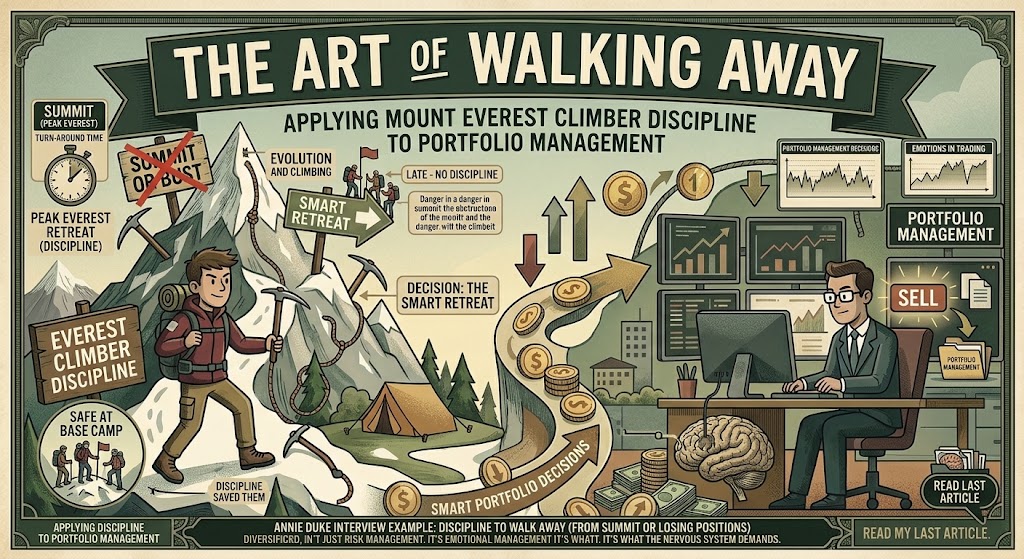
Annie Duke uses the Everest climber's discipline as an example. One I think about often. Climbers set what's called a turnaround time before they ever leave base camp. A fixed hour, or a fixed altitude, by which they must turn back and descend, no matter how close the summit looks. It's not about giving up on the goal. Because the version of you standing 200 meters from the top, oxygen-starved and exhausted, is precisely the version of you least equipped to make that call honestly. So, you don't let that version decide. You let the version of you at base camp, clear-headed and rested, decide for you.
Walking away is the only real antidote to the trader option, and it only works if the decision to walk was made before the pressure arrived, not during it.
Why It's So Hard
I've been thinking a lot lately about why walking away feels like losing a piece of yourself, rather than just changing your mind. Annie Duke has a line I can't get out of my head since I've heard it: Our beliefs are the thread our identity is woven out of. Attack the belief, and it feels like you're attacking the person.
I don't think decisions are so different. The position, the deal, the relationship you've committed to, at some point it stops being a decision you made and starts being part of who you are.
Which is exactly why you decide the framework ahead of everything else. Because when emotions run high, you forget the reasoning that set it.
Not in the moment. Before the moment.
Value. Recoded. Again.
So back to my friend in his Mayfair office, with his thirty-year-old Patek quietly doing its one job without asking anyone to notice it. Maybe that's the whole point. The people who are best at walking away aren't the ones announcing the exit. They're the ones who set the terms long before anyone else even realized a decision was being made.
It’s true: the hardest part was never the leaving, it’s knowing, ahead of time, exactly what would make you go.
-Jenny Ngan, Head of Business Development
#ValueRecoded #ValueInvesting #Munich #Finance #EuropeanSmidCap
Disclaimer
Maat Investment Group GmbH ("MAAT") is authorized as an investment firm (Wertpapierinstitut) by the German Federal Financial Supervisory Authority (Bundesanstalt für Finanzdienstleistungsaufsicht, "BaFin") and is registered with the U.S. Securities and Exchange Commission (SEC). MAAT only transacts business in the U.S. in states where it is properly notice filed or is excluded or exempted from registration requirements. Authorization by BaFin and registration with the SEC does not constitute an endorsement of the firm by these regulators and does not mean the advisor has attained a particular level of skill or ability.
This post reflects the personal views of the author and does not necessarily represent the views of MAAT Investment Group. It is provided for general information and educational purposes only and should not be considered investment advice, nor an offer, solicitation, or recommendation to buy or sell any security or to invest in any fund or strategy. Any businesses, transactions, or situations referenced herein, including those described in generalized or anonymized terms, are used solely to illustrate a general point about decision-making and are not intended to identify any specific investment held by MAAT, past or present, nor to constitute a recommendation with respect to any security.
There is no guarantee that any investment objectives will be achieved. Past performance is not a guarantee or indicator of future results. Any figures referenced, including historical share price movements or yields, relate to a specific point in time and should not be relied upon as indicative of future performance or of any current MAAT position.
Certain statements herein may constitute "forward-looking statements," which can be identified by terminology such as "may," "will," "should," "expect," "anticipate," "believe," or the negatives thereof or comparable terminology. Due to various risks and uncertainties, actual events, results, or performance may differ materially from those reflected or contemplated in such statements. Nothing contained herein may be relied upon as a guarantee, promise, assurance, or representation as to the future. Please seek advice from a suitably qualified professional before making any investment decision. Capital is at risk.