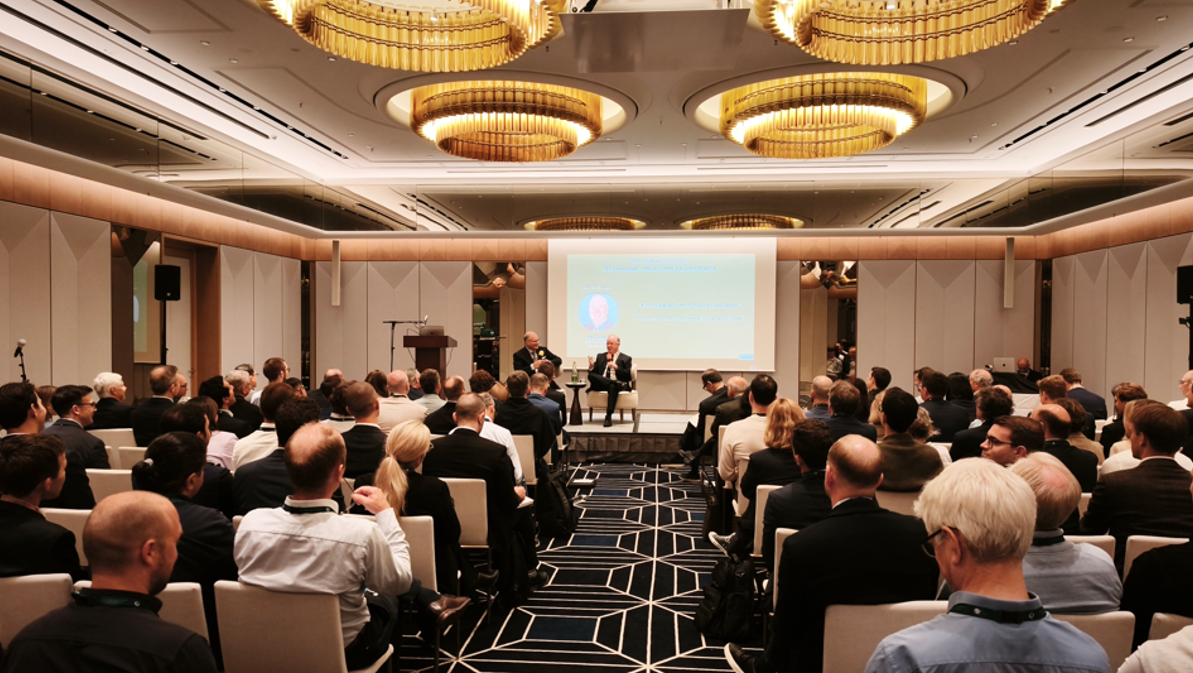
There is a lot of wisdom embedded in Mr. Gayner’s fireside chat. The width and depth of the topics raised by the ever so insightful Jeff Stacey should have been given the whole morning, instead of a couple of hours.
The most memorable thing about the whole talk is not that the concept is complicated. It's the opposite. It comes so naturally, so organically, that the phrase from a small town in Virginia, forty years running, is the one I find myself reflecting on over the weekend.
The Richmond Problem
Markel IPO'd at $8 a share. Gayner has now been there 36 years, and by his own math, the stock has roughly doubled eight times since.
Eight doublings.
Eight drawdowns of 20% or more along the way too, one of which, he mentioned almost offhand, is happening right now (talk about brutal honesty).
But it's not the math that stuck with me. It's Richmond.
He told the room: The stock goes from 8 to 16. Good. Then it gets to 32. And somewhere around there, a phrase starts making the rounds in a town that isn’t that big. "Oh, I missed it. I missed it."
Then it sits. Sideways, for a while, long enough that the FOMO wears off and something worse sets in: quiet confirmation bias. Yeah, it's done. They've lost it. And then, in his words, something out of an asteroid hits the earth, and it doubles again. And the same people, now at 64, say the exact same thing.
Here’s the line that undoes the whole cycle: "The same people who were there from 8 to 16 and 16 to 32 are still going to work every day." Not the exact same people, forty years on, as we know retirements happen. But the same values. The same style. Still at work.
I bet nobody in Richmond missed anything. They just kept starting over, somewhere else, every time the story went quiet for a stretch. But Gayner never did.
Finishing When It's Uncomfortable
It's easy to admire discipline from a distance, in a story, told well, forty years after the fact. It's a different thing entirely when the drawdown is happening right now, mid-sentence, while you're the one talking.
Which is exactly what he did. Markel is down from a high in the 2100s to the 1750s and 1800s as he’s speaking, and he says it plainly: "I’ve been buying, by the way." Not a retrospective. Present tense. He described reading the New York Times for a month and counting 27 out of 30 days carrying some version of an anti-alcohol story, an entire cultural mood turning against a category he holds real positions in (Diageo, Brown-Forman, Pernod). His conclusion, delivered with the same shrug he gave everything else: "I have decided to ride that horse. Let’s see how this plays out."
And then there's Graham Holdings, the company formerly known as the Washington Post Co., where the actual product, the physical newspaper, did in fact become obsolete. His own test for that: Would you start this business today? For newspapers, no. But the company itself didn't get to stop and restart from scratch. It had to finish what it was already doing, capital allocation decision by capital allocation decision, until the name on the door no longer matched what was inside it.
Process, Process, Process
One thing dawned on me, after so many conversations with different people: willpower is not a system. A system is a system, built precisely because you cannot count on willpower showing up every time you need it.
I suspect Mr. Gayner figured that out a while ago. He didn't just decide to be someone who finishes things. He built a capital allocation hierarchy that makes starting something new the last option on the list, not the first.
And the idea is beautifully simple: Fund the businesses you already own. First. Then new platforms. Then public securities. Buybacks, last. Read that order again. It is not a list of where the best returns might be found. It is a list of where his obligations already are, ranked by how long he's been carrying them.
Same logic sits underneath his four investment lenses, where reinvestment dynamics, not price, is the one that matters most. Price is what you pay to start something. Reinvestment is what lets you keep finishing it, year after year, without needing a new idea to feel productive.
Where the Patience Comes From
Which gets at something underneath all of it. The hierarchy tells you what he does, but not how he's able to keep doing it, quarter after quarter, drawdown after drawdown. That part is temperament, and it comes, by his own account, from failing at the opposite.
"I became such a long-term investor because I failed so miserably as a short-term investor."
He said it almost like a confession, then told the room about his father’s line: There’s always somebody smarter, somebody faster, somebody stronger. You have to find the one thing you’re better at than most people. His is patience.
He put it in terms of a foot race: Not a sprint, he’d lose that badly and knows it. Not even a mile, still Usain Bolt’s, probably. But a foot race from Key West to Seattle, that’s a different competition entirely.
"It’s about will. It’s about endurance. It’s about the ability to put one foot in front of the other no matter what."
That is the whole edge, I think. Not the next idea. The discipline to stay with the one you already have.
We think about this a lot at MAAT, more than people probably realize. It is tempting, always, to mistake a quiet stretch for a wrong one. To start looking for the next name the moment the current one goes sideways for a while. Gayner's version of patience is not a personality trait. It is a policy. It's a process. It's a system that knows our human fallacy and guards against it: Fund what you already own first. Buy back your own stock last. Somewhere in between those two decisions is forty years of compounding, and not one of them was a new idea.
It's true:
"Stop starting. Start finishing."
-Jenny Ngan, Head of Business Development
This post is for informational and educational purposes only and does not constitute investment advice, research, or a solicitation to buy or sell any security. Companies mentioned are discussed for illustrative purposes only and are not recommendations. Any views attributed to Thomas Gayner are his own, drawn from his remarks at the Ben Graham Center's 6th European Value Investing Conference in Munich, and do not reflect the views of, nor are they endorsed by, Maat Investment Group. Maat Investment Group GmbH is licensed by BaFin (reference 10164363) and registered with the U.S. SEC (CRD: 332840).